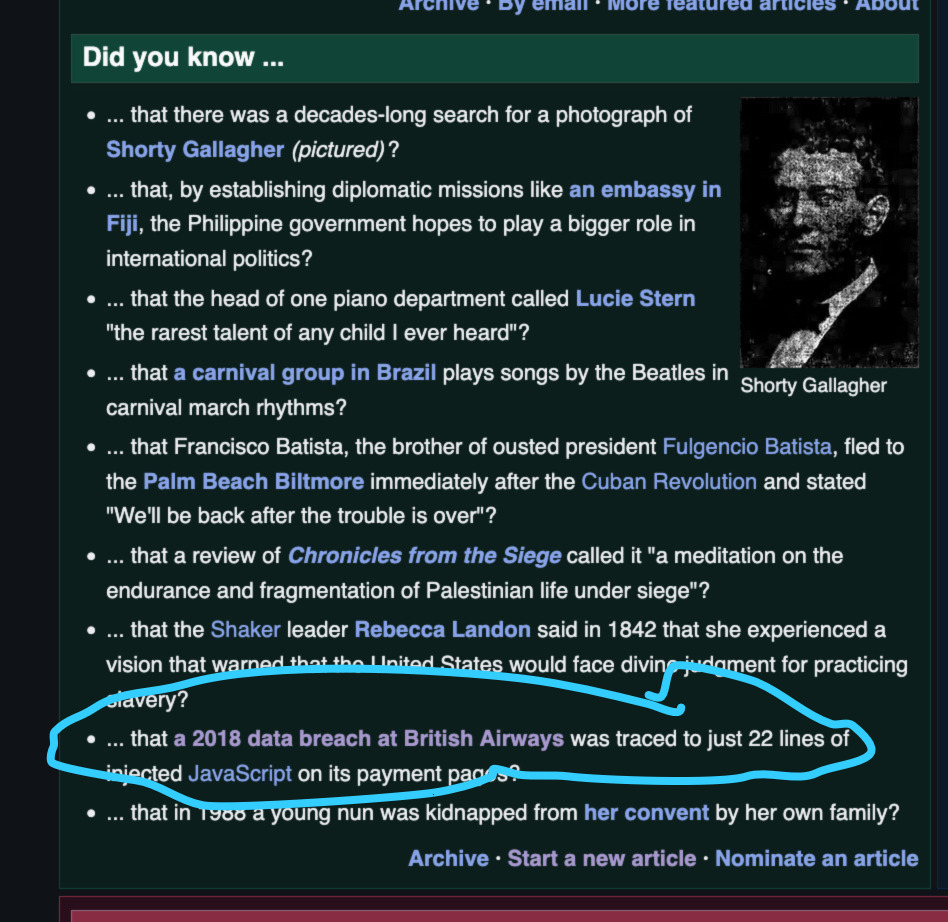
I had two articles on the front page of Wikipedia this week
Last term I taught my data breach case studies from three Wikipedia articles (all of which I’d worked on a lot). This was actually super interesting to do, because:
- I knew what I was talking about - and more importantly, I knew what I was talking about in a way that was convincing to the students.
- There’s a lot of information about the cases that doesn’t make it into Wikipedia (to be fair, it’s mostly gossip and unsubstantiated things), and it’s interesting to talk to the students about that.
- The students were about to do their large bit of coursework, and it’s nice to be able to illustrate how necessary sourcing is.
Since then, I’ve been on a bit of a push with editing Wikipedia. I took all three of those articles through the Good Article Review process, and also created another one (again, on a data breach) and took that through the Good Article Review process.
Once an article has been through the Good Article process, you get a little green plus sign, and you can nominate it to be featured on the ‘Did you know’ section of the front page. I went through the process with two of the articles (With a third in April), and eventually they ended up on the front page!
Things I learned:
- Good Article reviews are disproportionately done in the ‘push’ months. I spent a lot of time waiting for the review, and if I had been more aware of the calendar, I might have understood that better.
- Because I’m only writing about data breaches at the moment, I find it easier to reply to reviewers, either because I’ve had a different reviewer with an entirely opposite opinion that I can reference, or because I’ve already written an explanation for a common issue and I can literally copy-paste it.
- There is a page called ‘what the Good Article criteria are not’, which turns out to be amazingly useful when responding to reviews and shortens them dramatically. It effectively means you can split the review into “Things that need to happen now” and “Advice for the future”.
- Because articles on the front page get so many more views (presumably disproportionately from Wikipedians because they are heavier users of the front page), a bunch of edits happen from passing users. Mostly it’s fixing their pet peeves or some small aspect of the Manual of Style, but it’s really interesting to see how much it amounts to a group peer review. You can also nominate for the Did You Know page with new articles, and I think I might give that a go next time I create one - it probably smooths the path to things like GA.
I’m certainly going to be in a better position to do the same lecture next year.
Thank you to everybody who reviewed, edited, or popped by with opinions.